 Home
Home  About us
 Partner
  Products
 News
News Certificate
 Contact Us


Focusing on continuous improvement to enhance quality and efficiency.
Huahong Technology has conducted specialized training on lean management practices at the grassroots level.
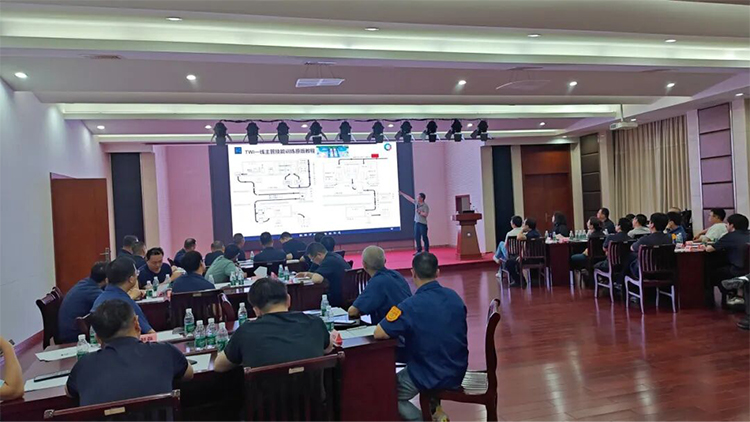
To further strengthen the lean management system, enhance grassroots management capabilities, and improve frontline supervisors' skills in addressing operational issues, optimizing processes, and mentoring teams, Huahong Technology recently conducted specialized training sessions on TWI-JI (Work Instruction and Improvement) and TWI-JM (Work Process Improvement), leveraging lean principles to foster talent development and drive high-quality corporate growth.
This training program featured renowned lean management expert Song Boya as the keynote speaker, targeting the company's core lean practitioners and frontline workshop supervisors. Through a comprehensive approach combining theoretical explanations, case studies, hands-on exercises, and group discussions, it addressed key challenges in on-site management and delivered standardized, actionable, and replicable lean tools—content that is closely aligned with real-world production needs and highly practical.
01.Work Training: Standardize standardized workflows and facilitate skill inheritance
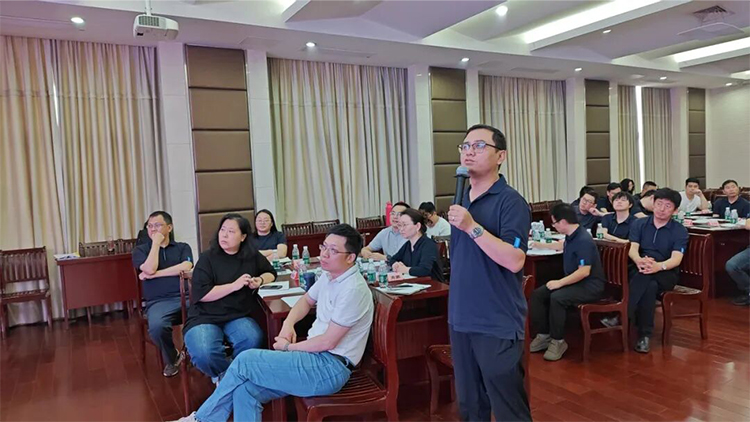
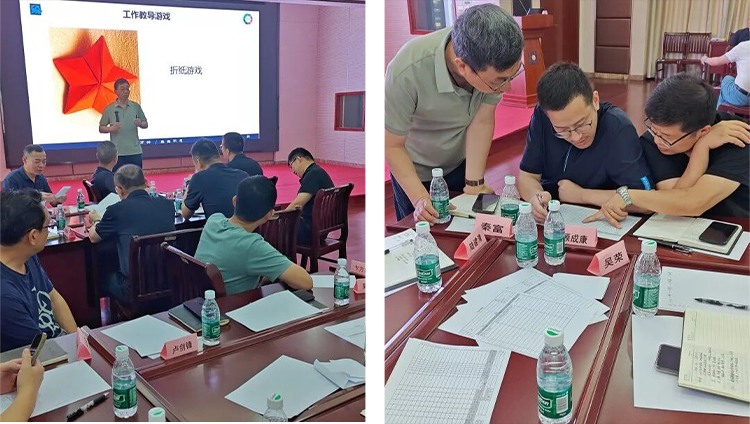
"Being able to perform tasks" does not equate to "being able to teach." The training addresses common pitfalls in daily mentoring practices, systematically breaks down the core principles of TWI-JI instructional methodology, and details the four-step standard process—task preparation, hands-on instruction, trial practice with error correction, and follow-up supervision—to help participants develop a standardized, scientific approach to job mentoring. During the session, participants engaged in practical exercises, working in groups to develop and implement task breakdown tables and skill training plans.
02.Work Improvement: Find solutions by identifying problems and enhance efficiency through optimized processes
Lean improvement lies in the details, while quality enhancement and efficiency improvement stem from practical action. The training focuses on the TWI-JM work improvement module, integrating real-world production scenarios to convey the lean philosophy that "problems are opportunities for improvement." It outlines a standardized improvement process encompassing step-by-step decomposition, analysis of current conditions, clarification of uncertainties, proposal development, and implementation validation.
Meanwhile, the course employs balanced improvement principles—including elimination, consolidation, reorganization, and simplification—to guide participants in thoroughly identifying production waste and process bottlenecks within their specific roles. Through hands-on group discussions and solution optimization exercises, participants rapidly acquire practical methods for diagnosing on-site issues, refining processes, and reducing costs while enhancing efficiency, thereby comprehensively strengthening their lean improvement capabilities.
Promote action through training, put knowledge into practice through action, and jointly build a path toward excellence.
This training program concluded successfully amidst enthusiastic practical sessions and interactive exchanges. The participants not only mastered the core TWI lean tools but also firmly established a company-wide lean philosophy characterized by universal understanding of lean principles, consistent application of lean practices in all tasks, and continuous improvement efforts across all areas.
Huahong Technology will routinely conduct lean training programs to ensure the thorough implementation of TWI-based work guidance and improvement tools. By establishing standardized practices to strengthen management foundations and leveraging refined improvements to enhance quality and efficiency, the company aims to continuously invigorate grassroots management, reinforce its core competitiveness, and support sustained, stable, and high-quality development.
High places bring great cold; safety must never be forgotten.
Huahong Technology conducted a specialized training session on working at heights.
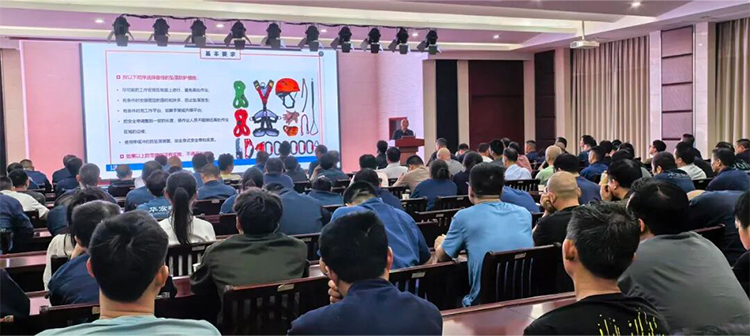
To enhance employees' safety awareness and improve their risk management capabilities for high-altitude operations, Huahong Technology recently conducted a specialized training session on high-altitude work. The session covered fundamental concepts, classification standards, essential knowledge and skills required for personnel, as well as key aspects of on-site safety management. The event was delivered by speaker Pan Zhengqing, who provided a comprehensive presentation.
The training focused on common types of elevated work operations, including work at edges, openings, climbing, suspended positions, and crossover operations. It employed a "five-step classification system" to categorize such operations into Levels I–IV based on height and environmental conditions, facilitating the implementation of targeted safety measures.
Regarding essential personnel knowledge and skills, the training emphasized the following requirements: safety protective equipment must be inspected before commencing operations; access must be via designated routes, and playing or roughhousing is strictly prohibited; materials shall be stacked securely and not discarded downward; outdoor operations must be immediately halted during severe weather conditions such as winds of force 6 or higher or dense fog.
The training also utilized fall risk data to emphasize that the average time from perceiving a hazard to initiating a response is 0.75 seconds, during which individuals have already fallen approximately 3 meters; by the third second of the fall, the velocity approaches 100 km/h and the height exceeds 40 meters. Relying solely on rapid reaction cannot ensure survival; it is imperative to adhere to the principle of "protection first, then operation."
Huahong Technology will continue to enhance safety training and on-site inspections, implement systems such as acceptance of protective facilities and regular maintenance, ensuring that every employee commutes to work happily and returns home safely.